
BRIEF OF AMICI CURIAE JOHN PAUL BEAUDOIN, SR., HENRY EALY, JOSHUA GUETZKOW AND KEVIN McKERNAN
Right to Redress; 360bbb-3 Informed Consent; Court Dismissals Without Justice

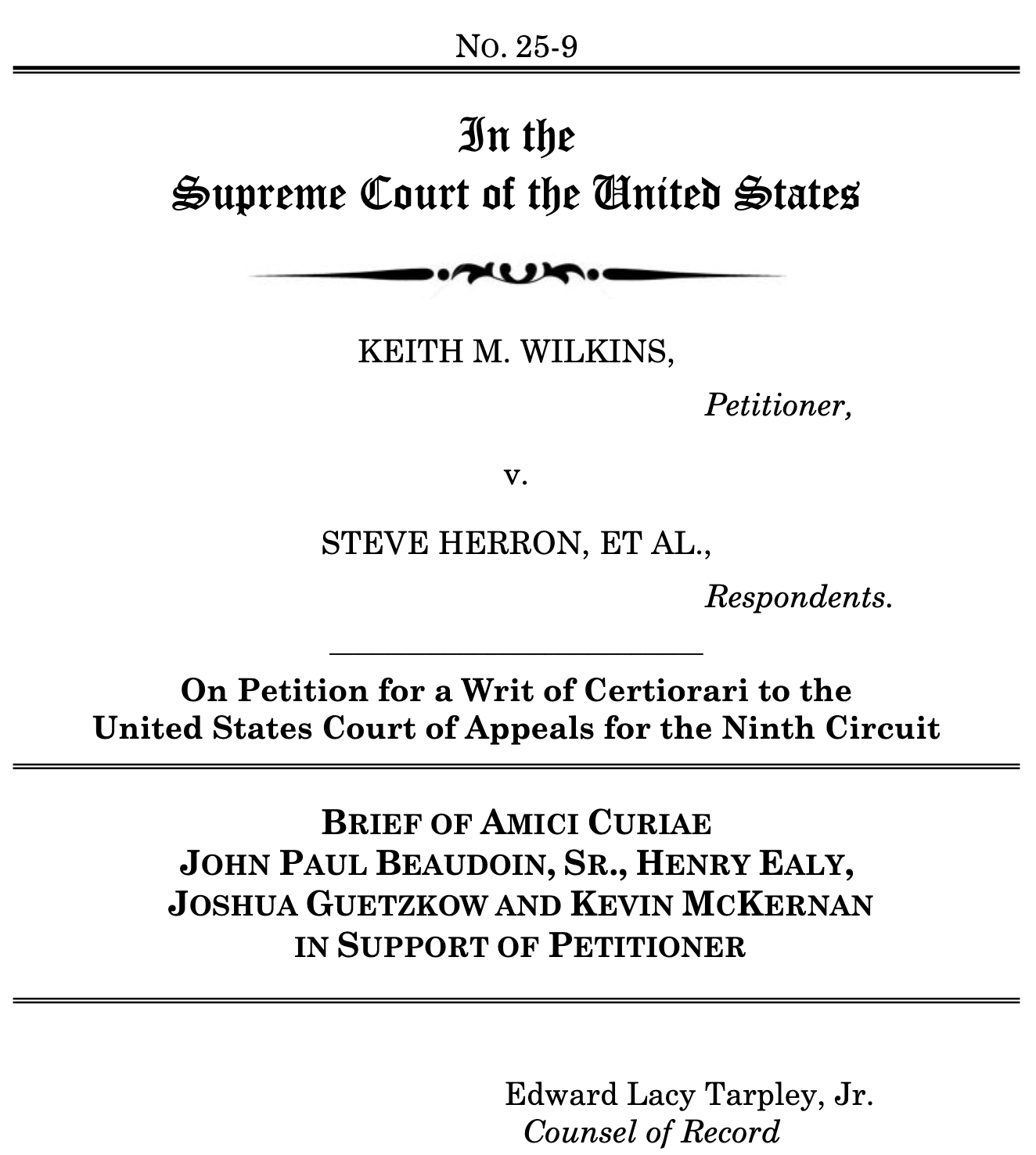
Below is the text of an amicus curiae brief filed in the Supreme Court of the United States in the case Wilkins v Herron et al Docket No. 25-9.
The brief can be found here: https://www.supremecourt.gov/DocketPDF/25/25-9/368712/20250801193157030_BeaudoinWilkins%20MAIN%20EFile%20Aug%201%2025.pdf.
Skipping Table of Contents and Table of Authorities
My apologies to the reader for footnote locations. The format from the brief would not port. I put them at the bottom of each appropriate section.
INTEREST OF THE AMICI CURIAE
Amici curiae JOHN PAUL BEAUDOIN , SR. and DR. HENRY EALY are individuals who suffered violations of the most foundational right of civil society, which is the right to petition the government for a redress of grievances and access of the courts for cases and controversies, both of which are defined and protected by the laws and Constitutions of the United States and the Commonwealth of Massachusetts.
Amici curiae JOSHUA GUETZKOW and KEVIN McKERNAN are subject matter experts and individuals, who wish to provide this Court information uniquely important to understanding the broader implications of Wilkins’ petition for certiorari.
Amicus Beaudoin is a systems engineer and MBA with thirty (30) years in whole systems analysis.
Amicus Ealy is a naturopathic physician and healer.
Amicus Guetzkow is Senior Lecturer, Dept. of Sociology and Inst. of Criminology, Hebrew University.
Amicus McKernan is a genetic scientist and founder of three successful genetics research companies.
Throughout this brief, the Amici utilize perspectives usually absent from one at bar including the intersections of law, economics, philosophy, psychology, and sociology.
This Amici Curiae brief is submitted in support of the Petitioner.
Footnote1
SUMMARY OF ARGUMENT
One of the most foundational rights in the United States Constitution is found in the First Amendment, “Congress shall make no law … abridging … the right of the people … to petition the Government for a redress of grievances,” which is effectuated through access to the Article III § 2 courts.
The fundamental rights of American citizens cannot be upheld without citizen access to the courts to petition for a redress of wrongs or injustices in society.
I. Issues
Petitioner Wilkins and many other plaintiffs sought redress in the courts in the Covid era, but were denied access via a myriad of civil procedure doctrinal decisions incidental to the substance of the cases. Qualified and sovereign immunity, mootness, ripeness, “standing,” “failure to state a claim,” and narrow interpretations of legislative intent were used to dismiss righteous grievances such as Wilkins’ complaint.
The glut of dismissals and the omission of discovery resulted in opportunism by bad actors: 1) Pfizer switched the manufacturing process from Process 1 submitted to federal regulators for Emergency Use Authorization (“EUA”) in trials to Process 2, a cheaper and more dangerous process for mass production, 2) Pfizer deleted annotation of dangerous DNA plasmid contamination in the product before submitting the documentation to federal regulators, id est, they hid it from The People, 3) States committed Covid over-counting fraud as a matter custom and practice, and 4) Covid “vaccine” as a cause-of-death was fraudulently omitted from state death records thereby preventing “informed consent” from manifesting.
More than a million excess deaths and tens of millions of injuries ensued in the United States since 2021. These are facts provided in the arguments, not mere speculation or hyperbole. If discovery or trial were had in a few cases in 2020 and 2021, many of these deaths and injuries could have been avoided.
Specifically, in Wilkins, 21 U.S. Code § 360bbb-3(e)(1)(A)(ii) confers a right to “individuals” to be “informed” of the “benefits and risks” of experimental pharmaceutical products. The courts have interpreted 21 U.S. Code § 337 to mean that only the United States may bring suit under all Chapter 21 statutes.
Notwithstanding § 337, it is implausible that the legislative intent of 360bbb-3(e)(1)(A)(ii) expressly protecting an individual’s right to informed consent was intended solely for the Government to seek “remedy” from the courts against the Government.
II. Solutions
The purpose of this brief is to expand the broader implications of Wilkins’ petition for certiorari. Amici wish to 1) affirm the primary mission of the courts, 2) assert that most, if not all, civil procedure decisions are equitable matters, and 3) interpret the scope of § 337 to mean the literal words written in the statute.
III. Implementations
If the primary mission of the courts is dispute resolution, then a dispute unresolved is failure. The courts should interpret all procedural hurdles in a light most favorable to plaintiffs in order to preserve the right to petition for redress. Only the most egregiously frivolous cases should be dismissed.
“Standing” and other dismissal doctrines are such abstract prose that they effectively leave dismissal decisions to the judges, not the law. Judge-only decisions are equitable decisions. Thus, dismissal decisions should be balanced against the plaintiff’s right to petition for a redress of grievances. Violation of such a foundational right is an extreme departure from civility.
Lastly, Amici recommend a reinterpretation of § 337 to its literal interpretation. “Enforcement” and “restrain” are not all consuming of the locus of “remedy” or “redress” — argument infra.
The dismissal affirmation from the Ninth Circuit in Wilkins stated, “ . . . since the onset of the COVID-19 pandemic, numerous courts have rejected claims that COVID-19 vaccine mandates or mask mandates violate individuals’ substantive due process rights, which illustrates that any purported due process right to refuse a vaccine or to wear a mask during a pandemic was not clearly established.” This statement alone from a U.S. Circuit Court of Appeals showcases the wanton overuse of dismissal doctrines depriving The People’s fundamental right to access the courts.
Denial of access results in omissions of dispute resolution. As a result, a million Americans died from government orders, not from Covid.
A grant of certiorari in the present case is an important step in healing the American judicial system.
ARGUMENT
I. The Primary Mission of the Courts is Dispute Resolution
The primary mission of the courts is to interpret and apply law, resolve disputes, and uphold the Constitution. If a free people cannot access the courts to resolve disputes, they will devolve to neighbor fighting neighbor, citizen fighting government, and the greater power will win, regardless of the validity or righteousness of a claimant’s cause. Across the Western world, denial of court access allowed governments to subjugate individual rights under the guise of emergency law.
The courts have gone awry from their primary mission of dispute resolution because civil procedure doctrines are hyperbolically and incongruously interpreted by lower courts in violation of plaintiffs’ rights of redress, access to the courts, and due process. Wilkins is but one example of such a violation of First Amendment rights.
II. Civil Procedure Decisions are Equitable Decisions
Juries are not involved in the pleading stage of a case. Judges dismiss cases using a myriad of technicalities including interpretation of legislative intent, imminence level of an injury-in-fact, attenuation level of traceability, speculation level of redressability by the court, plausibility of the claim, or insufficient facts to confer standing in the plaintiff’s “short and plain statement.” Lujan v. Defenders of Wildlife, 504 U.S. 555 (1992); Bell Atlantic Corp. v. Twombly, 550 U.S. 544 (2007); Ashcroft v. Iqbal, 556 U.S. 662 [2009].
The Rules Enabling Act, 28 U.S. Code § 2072, gave power to this Court in 1934 to make rules of evidence and of civil, criminal, appellate, and bankruptcy procedure. Local Rules were added. Further, decisions from this Court have created an intricate web of abstract prose resulting in lower courts dismissing righteous cases that are inconvenient or controversial.
Most civil procedure doctrinal dismissals are equitable matters whereby balance of equities and the public interest should effectively be the determinants of outcome.
Strict scrutiny, for example, gives weight to a “compelling state interest.” However, that weight should be balanced against the plaintiff’s right to petition for redress. Id est, a balance of equities analysis is warranted. The framework of strict scrutiny adds complication to effectively equitable procedural matters. The framework fosters dismissals as lower courts opt for convenience.
To summarize: civil procedure decisions are mainly equitable matters; courts omit the balancing test of individual rights versus the public interest; courts often rely upon incongruous case law; and courts overlook the unique aspects of each case while omitting individual case scrutiny — all of which occurred in Wilkins v Herron et al. Wilkins deserves the right to petition for redress.
III. Implausible Inerpretations of the Legislative Intent Behind § 360bbb-3(e)(1)(A)(ii) and § 337
The pertinent portion of the statute involved states, “ . . . designed to ensure that individuals to whom the product is administered are informed . . . of the . . . risks . . . , and of the extent to which . . . risks are unknown . . . ” 21 U.S.Code § 360bbb-3(e)(1)(A)(ii)
Given the express callout that “individuals . . . are informed,” it is implausible that the lawmakers’ intent was for government to be the sole means of seeking “redress” and “remedy.”
42 U.S. Code § 1983 holds state actors responsible for deprivation of rights. Amici argue that § 360bbb-3 expressly confers the right to informed consent, was purposely included by lawmakers, and that the (ii) “individuals” clause is useless unless upheld by § 1983.
Amici’s Main Point in this Brief
21 U.S. Code § 337(a) states, “ . . . enforcement, or to restrain violations, of this chapter shall be by and in the name of the United States.” The literal meanings of “enforce” and “restrain” do not encompass the full locus meaning of “remedy” or “redress.”
“Enforce” means “to effect by force.”
“Restrain” means “to prevent from doing.”
“Redress” means “to set right” or “to make up for” or “to exact reparation for.” Merriam-Webster, https://www.merriam-webster.com/, last visited 2025 July 28.
“Enforcement” and “restrain” are words involving force. Amici agree that only the government should be allowed to force a violator to do a legally required act or refrain from doing an illegal act.
“Redress” is a different concept and larger locus of meaning than “enforcement.” “Redress” includes remedies in law and equity that have nothing to do with enforcement. The violative act and injury in Wilkins are in the past and cannot be undone. If the government wants to force the defendant to provide informed consent, that is a different matter than compensatory damages in law or restitution damages in equity sought by Wilkins through § 360bbb-3 and § 1983.
To summarize, Amici agree that § 337 provides that only the United States may “enforce” § 360bbb-3. However, Wilkins seeks not “enforcement,” but rather remedy, which is not precluded by § 337.
Amici implore this Court to reconsider the written words, fairness, and equity in deciding legislative intent. Given the consequences of dismissals during Covid, The People’s rights should be preserved. Let it begin with Wilkins. Amici assert that “redress” and “remedy” were not intended to be precluded via § 337.
IV. Systemic Lower Court Dismissals and Inefficiencies Result From the Omission of Balance of Equities Analyses in the Pleading Stage
In response to the Covid pandemic, federal and state governments declared emergencies that triggered wartime emergency powers. Governments quickly effectuated emergency orders claiming that the public interest subjugated individual rights. In Massachusetts, The Acts of 1950, known as civil defense law, was invoked.
Mandates to mask, limit occupancy, social distance, and Covid “vaccinate” were enacted by governments without supporting evidence in some cases and with scientific evidence now proven fraudulent in other cases.
The violative mandates were met with lawsuits from citizens seeking redress. Then ensued a governmental pattern of rescinding, reinstating, and carving out exceptions to mandates. This pattern clearly demonstrates intent to manipulate the courts using dismissal doctrines in order to avoid any substantive evidentiary analysis.
Discovery was intentionally avoided because facts demonstrate that many mandates have net zero or net negative effects to society. In such cases, a balance of harms analysis would have resulted in all mandates struck down by the courts.
A micro-level view of each case fails a “judicial economy” analysis. One example case could have gone through discovery in two months, followed by a two-day trial. Alternatively, the complaint, motion to dismiss, opposition memorandum, reply brief, and other filings took two years and cost nearly a hundred thousand dollars. This is not a justice system, but rather a procedure system.
In the Wilkins case, omission of equity balancing and public interest analyses in the evaluation of legislative intent left The People without an earnest probe into discovery evidence, which would have conclusively shown that the respondents’ “vaccine” mandate was based on fraud proven in arguments infra.
A. LAUSD Covid Vaccine Mandates
There may not be any clearer case of mootness doctrine abuse than the Los Angeles Unified School District. “LAUSD’s pattern of withdrawing and then reinstating its vaccination policies was enough to keep this case alive.” Health Freedom Defense Fund, Inc. v. Carvalho, 104 F.4th 715 (9th Cir. 2024)
The Opinion states, “This case is about LAUSD’s COVID-19 vaccination policy. LAUSD has reversed course several times.”
In order to avoid having a “vaccine” case heard, the school district dropped the mandate during litigation, moved for dismissal based on mootness, then reinstated the mandate after dismissal.
How many years and how much money were spent by the parties in this one case, while purposeful deprivation of rights was perpetrated by the defendants?
The LAUSD case is but one example in which time and pecuniary cost were several times more than if the case were to substantively be heard and run its course through evidence and trial in a few months.
The most economically efficient solution is for Wilkins to be granted certiorari, then let the case run its course in short time.
The micro-economic analysis is simple. Three years and several rounds of District and Circuit Court filings are multiple times more costly than a few months of discovery and a one or two day trial.
B. Massachusetts Mask Mandates
Massachusetts Governor Baker enacted COVID-19 Order No. 31, for population-wide face covering, on May 1, 2020 effective May 6, 2020.
All mask involved cases known to Amicus Beaudoin were dismissed and none reached discovery for fact finding. Beaudoin v. Baker, 530 F. Supp. 3d 169 (D. Mass. 2021) was also dismissed using “failure to state a claim” because Baker rescinded Order No. 31 and reissued a new mask mandate as Order No. 55 in November 2, 2020 . Order No. 55 ¶ 2(b) is an exception for hearing impaired and anyone speaking to anyone hearing impaired. Amicus Beaudoin complained he was deprived of receiving free speech from others because Baker ordered others to cover their mouths. Amicus Beaudoin needs to see people’s lips move to aid in hearing.
The case was then dismissed because Beaudoin no longer had an injury-in-fact. Baker’s ¶ 2(b) exception worked. The evidence that masks do not stop Covid never entered court.
Beaudoin received 1,263 pages of internal communications from Massachusetts Department of Public Health (“DPH”) within a day of the dismissal, five months after his Public Records Request. E-mail communication among Professor Gregory Rutledge of Massachusetts Institute of Technology and DPH agents conclusively shows that DPH agents knew on April 20, 2020, two weeks before the mandate, that masks do not stop COVID-19. Masks are useless against COVID-19 proven by billions wearing masks while COVID-19 spread the earth over. This information is found in The Baker Knew (2022, Beaudoin, J.).
That DPH agents knew masks do not work two weeks before the mandate was issued was never heard because of dismissal doctrines.
Amicus Beaudoin cycled through years of court filings never to have a substantive argument heard in a court. This is a second micro-economic example of inefficiency, while courts purport to dismiss cases for “judicial economy.”
Dismissing cases spawns more cases exponentially because legal matters are not solved.
The courts are failing in their primary mission of dispute resolution. Granting the Wilkins petition for certiorari will be a good first step to remedy the court’s failure.
V. Macro-Economic Analysis of Dismissal Doctrines
In 1992, the Supreme Court attempted to lasso a century of disparate Circuit-driven “standing” holdings by creating a three-prong test in Lujan v. Defenders of Wildlife, 504 U.S. 555 (1992). Lujan reigned in standing doctrine citations from 1992 until 2009, when began an exponential increase in citations and dismissals. Bell Atl. Corp. v. Twombly, 550 U.S. 544 (2007) and Ashcroft v. Iqbal, 556 U.S. 662, 687 (2009) accelerated the scope creep of standing doctrine to deny access to the courts.
While some try to differentiate “standing” from “failure to state a claim,” the two are entwined beyond reasonable inference to the contrary. Such differentiation matters little to the numerous plaintiffs denied access to the courts in violation of their First, Seventh, and Fourteenth Amendment rights and Art. III § 2.
To understand how the Supreme Court lost control of doctrinal dismissals by lower courts, merely look at the number of case citations of the most cited and most famous cases in American jurisprudence. Compare them to Twombly and Iqbal. (Google Scholar provided the following numbers on 2025 July 26.)
Lujan v. Defenders of Wildlife, 504 U.S. 555 (1992) Cited 44,273 times in the past 32 years — Average 1,384 citations per year.
Roe v. Wade, 410 U.S. 113 (1973) Cited 50,854 times in the past 52 years — Average 978 citations per year.
Brown v. Board of Education, 347 U.S. 483 (1954) Cited 59,511 times in the past 71 years — Average 838 citations per year.
Miranda v. Arizona, 384 U.S. 436 (1966) Cited 88,575 times in the past 59 years — Average 1,501 citations per year.
Anderson v. Liberty Lobby, Inc., 477 U.S. 242 (1986) Cited 243,071 times in the past 39 years — Average 6,233 citations per year.
Celotex Corp. v. Catrett, 477 U.S. 317 (1986) Cited 219,487 times in the past 39 years — Average 5,628 citations per year.
Strickland v. Washington, 466 U.S. 668 (1984) Cited 163,994 times in the past 41 years — Average 4,000 citations per year.
Bell Atlantic Corp. v. Twombly, 550 U.S. 544 (2007) Cited 297,529 times in the past 18 years — Average 16,529 citations per year.
Ashcroft v. Iqbal, 556 U.S. 662 (2009) Cited 289,336 times in the past 16 years — Average 18,084 citations per year.
This macro-level analysis using citation rates demonstrates an irrefutable systemic shift in the past 18 years. Most notably, Iqbal and Twombly citation rates and totals extend far beyond all others; and it happened in less than two (<2) decades time.
Petitioner Wilkins is caught in this systemic industrial shift in American jurisprudence. Custom and practice of defense attorneys and judges shifted emphasis to pleading stage from discovery and trial stages. These overused dismissal doctrines violate Americans’ First Amendment right to petition the government for a redress of grievances.
One solution is to grant certiorari for Keith Wilkins’ righteous petition. Let the restoration of American Constitutional rights and the correction of civil procedure begin with the right of Keith Wilkins and the American citizens to be informed of the risks involved in injecting DNA altering genetic material or any other material past the lung defenses and into our bodies.
VI. Actual, Not Merely Hypothetical, Consequences of Civil Procedure Doctrines that Prevent the People From Accessing the Courts when the Government Deprives the People of Rights
The dismissals of lawsuits during the initial pleading stage of litigation, by state and federal courts throughout the nation, precluded the following facts from being heard in a court of law. In the past five (5) years since the Covid pandemic began, state and federal governments have used every procedural trick to prevent truths regarding Covid treatment protocols and “vaccines” from reaching the spotlights of discovery and trial stages.
This subject matter has never been through a rich discovery process. In these years, the courts sided with governments in the pleading stage nearly every time and did not consider the right to petition for redress.
The following truths were likely kept from the Supreme Court until this brief.
A. Pfizer Switched Manufacturing Processes from Process 1 Used to Obtain EUA Authorization to Process 2 for Mass Manufacturing.
As a consequence of errant dismissals by state and federal courts, Pfizer opportunistically acted with impunity by purposely, knowingly, and recklessly submitting false documentation for EUA authorization.
Wilkins cannot have been “informed” of the “risks” because Pfizer misinformed the federal regulators and the federal regulators misinformed The People of the risks of Pfizer’s Covid “vaccines.”
Pfizer used two different manufacturing processes for its BNT162b2 (Comirnaty) COVID-19 vaccine— referred to as Process 1 and Process 2.
The clinical trials leading to the vaccine’s EUA authorization in late 2020 primarily used doses manufactured via Process 1. To meet the global demand for billions of doses, Pfizer scaled up production using Process 2. The significant differences in manufacturing processes include changes to the DNA template used to transcribe the RNA and the purification phase, as well as the manufacturing process of the lipid nanoparticles.
On the basis of FDA documents released via FOIA, it has been determined by Amicus Guetzkow that only 252 participants in Pfizer’s trial were administered Process 2 doses, which all came from a single vaccine lot. Id est, the vaccine administered to the public was not the same as the one tested on the vast majority of the 43,448 trial participants.
This switch undermines informed consent because the public was not informed that the vaccine they received differed from the one studied in the clinical trials.
Pfizer’s trial protocol amendment in October 2020 indicated that Process 2 doses would be administered to a small subset of participants aged 16-55, approximately 250 per vaccine lot, with plans for comparative safety analyses between Process 1 and Process 2 recipients. However, no public report on these comparisons has been released, and in a protocol update in September 2022 Pfizer deleted the October 2020 amendment from the protocol.
Process 2 introduced potential safety concerns, including DNA plasmid contamination involving the presence of the SV40 promoter-enhancer sequence in Pfizer’s vaccine (not present in Moderna’s) raising alarms about cancer.
Federal regulators overlooked critical safety testing for Process 2.
Wilkins could not have been provided informed consent given the bait and switch that Pfizer perpetrated on The People, and which was allowed to be perpetrated by federal regulators.
Footnote5
B. Pfizer Purposely Deleted DNA Plasmid Annotations when they Sought EUA Authorization for Covid “Vaccines”
Another consequence of errant dismissals by state and federal courts is further opportunism and shirking of duty by Pfizer and by federal regulators related to omission of documentation of product contaminant types and levels.
Wilkins cannot have been “informed” of the “risks” because Pfizer misinformed the federal regulators and the federal regulators misinformed The People of the risks of Pfizer’s Covid “vaccines.”
The mRNA “vaccines” are manufactured by creating DNA and then converting it to RNA. Among the target RNA particles created in manufacturing are residual (left over) DNA particles. The DNA particles can be dangerous. How much DNA reaches the stream of commerce and is injected into humans depends on further manufacturing steps to purify the product to acceptable levels, which are determined by federal regulators.
As determined by Amicus McKernan, samples of product tested via genetics testing show that Pfizer Covid “vaccine” products that reached the stream of commerce contained wildly unacceptable levels of residual DNA (contaminants) left over from manufacturing.
Moderna, on the other hand, takes these DNA contamination risks more seriously as their patents explain how this residual DNA in the mRNA “vaccine” platform can enter mammalian cells and possibly cause cancer.
The only plausible scenario regarding Pfizer’s documentation submission to federal regulators for EUA authorization of Covid “vaccines” is that Pfizer intentionally misled the regulators. The details are highly technical. However, this scenario is supported by numerous labs and research papers from around the world. The DNA plasmid contamination is a fact now admitted by Pfizer and federal regulators.
A second deception found by Amicus McKernan, and now obvious to regulators, is that Pfizer submitted to federal regulators a plasmid (DNA fragment) map that omitted the SV40 plasmid region. This omission is not possible unless someone at Pfizer manually deleted those annotations from the output of the commercial plasmid annotation software. Annotation software execution will annotate the SV40 region by default if SV40 plasmids are present in the samples under test.
The SV40 plasmid region is a very controversial DNA sequence because it contaminated the polio vaccines and is known to cause cancer in mammals. The SV40 plasmids do not appear to exist in Moderna’s Covid “vaccine” products.
Moderna manufacturing and documentation processes are evidence that Pfizer’s approach was reckless. Pfizer tried to hide the DNA contamination from the regulators and The People by omitting the SV40 DNA plasmid sequences from the documentation submitted to federal regulators.
These purposeful, knowing, and reckless omissions by Pfizer in their submission for authorization to federal regulators manifest in a whole failure of informed consent.
C. Consequences of State Government Fraud that Became Custom and Practice in the Covid Era
The case of Beaudoin v Baker, 1:22-cv-11356 (D. Mass. 2022) was dismissed under Rule 12 (b)(6) “failure to state a claim.” Exhibit F from Amicus Beaudoin’s complaint confirms large-scale fraud evinced from official Massachusetts death records.
Accidental deaths were labeled “COVID-19” deaths. These include blunt trauma to the head and torso, and acute fentanyl overdose. In some cases, they tested dead bodies for Covid. In other cases, they had a positive Covid test on file from months earlier. Federal incentives drove this fraud.
Covid “vaccine” deaths were fraudulently labeled “COVID-19” caused deaths.
Brianna McCarthy, 30 years old, was certified a “COVID-19” death. Her headache began hours after Moderna Covid “vaccination.” Brianna died from ischemic stroke days later. Six (6) doctors reported that the “vaccine” killed Brianna by stroke. Brianna’s death record stated she died from “COVID-19.” Massachusetts had a positive Covid test on file from three months earlier though she was asymptomatic. Brianna’s death record stated that Covid caused her stroke. After three (3) years of pressure to Massachusetts, Moderna “vaccine” was added as a cause of death to her record in 2024.
In March 2021, in Massachusetts, two weeks before Brianna was injected, Diane Dubois, 62 years old, died from stroke after her Covid “vaccination.” Diane’s death record states vaccination was a cause of death.
In May 2021, in Massachusetts, five weeks after Brianna died, Eden MacDonald, 17 years old, died. Eden had a severe headache after Covid “vaccination.” Eden died days later from stroke. Her death record omits mention of Covid “vaccination.”
In August 2022, in Massachusetts, Amaya McDonough-Rocha, 12 years old, was injected with four vaccines, including her third Covid “vaccine.” Amaya died August 29, 2022 from stroke. Her death record omits mention of Covid “vaccination.”
Cassidy Baracka, 7 years old, in Massachusetts, is believed to have been Covid “vaccinated” on January 13, 2022, reacted immediately with terrible abdominal pain, and died January 18, 2022, five days after injection. The only cause listed in Part I of Cassidy’s death record is “COVID-19.”
The facts and circumstances of Diane’s, Brianna’s, Eden’s, Amaya’s, and Cassidy’s true cause of death being Covid “vaccination” were never heard by the U.S. District Court in Massachusetts because Amicus Beaudoin’s case was dismissed at the pleading stage.
Amicus Beaudoin discovered in official state records more than one hundred Connecticut decedents who died within two days of Covid “vaccination.”
Amicus Beaudoin calculated that more than 250,000 excess acute kidney injury involved deaths occurred in the United States since Covid treatment protocols and Covid “vaccines” were recommended by the U.S. Health and Human Services (“HHS”) department. HHS has not investigated this epidemic.
Several thousand excess cardiac arrest, cardiac arrhythmia, pulmonary embolism, stroke, GI, and other clotting and bleeding involved deaths occurred in Massachusetts since Covid “vaccinations.”
Lymphoma in Massachusetts was about four hundred percent (~400%) of normal in 2023. Bone marrow cancer is significantly high in Massachusetts, possibly explained by the DNA contamination now proven in Pfizer’s “vaccines,” though omitted from their literature submitted to the Food and Drug Administration (“FDA”).
The Centers for Disease Control and Prevention (“CDC”) was caught omitting “Y59.0” as a cause of death from death records when applying codes that represent causes. The code “Y59.0” means “viral vaccine” and was used in early 2021 on death records that state “vaccine” or “vaccination” as a cause of death. After early 2021, “Y59.0” was not applied to death records containing “vaccine” or “vaccination” in three states for which Amicus Beaudoin has official records. CDC must have purposely deleted “Y59.0.” No one can track “vaccine” caused deaths without “Y59.0” on death records.
Given the massive fraud in covering up Covid “vaccine” deaths and over-counting Covid disease deaths, it is likely that a million people died and tens of millions are injured in the United States. The evidence is irrefutable.
These deaths and injuries flow from the omission of access to the courts. Dismissal doctrines and errant interpretations of legislative intent fostered continued fraud from governments.
Also implausible is that the legislative intent of the Rules Enabling Act was to give unlimited power to the judicial branch to block access to the courts. Technicalities drawn from incongruous case law was never meant to subjugate the right to petition for redress.
But for the dismissals of Wilkins and Amicus Beaudoin’s cases, courts would have heard the true evidence years ago, and the public would have been “informed” of “risks” as is their express right stated in § 360bbb-3(e)(1)(A)(ii).
Footnote8
VII. Solutions in the Context of Wilkins
It is important to solve the micro- and macro-economic systemic inefficiencies of the courts given the horrific consequences that flowed from them. This should begin with Wilkins.
The dismissal of Wilkins should be reversed and remanded as a first step to restoring the rights of The People to access the courts. The lives of one million Americans were taken because the truth was hidden behind dismissal doctrines.
This Court has a moral duty to solve these issues before the United States descends into incivility.
Solutions include:
Civil procedure decisions should be considered effectively equitable matters,
As equitable matters, dismissals and other procedural decisions should undergo balance of equities/harms and public interest analyses involving the right to petition for redress,
§ 337 should be re-interpreted to allow a private right of action in redress and remedy, but not enforcement of Chapter 21 statutes including § 360bbb-3,
§ 360bbb-3(e)(1)(A)(ii) should be interpreted to expressly convey a right to an “individual” to be informed of risks of EUA products,
§ 1983 should be interpreted as the means by which the right bestowed in § 360bbb-3(e)(1)(A)(ii) may be remedied if violated.
The facts set forth in this brief demonstrate the consequences of the past two decades of doctrinal dismissals. A million Americans are dead, yet no redress. Rampant state and federal agency fraud was committed against The People, yet no redress.
A systemic shift in the litigation industry manifested in judicial economy tuned to dismissals by sacrificing justice and equity.
We all know someone needlessly injured or killed by a Covid “vaccine.”
Granting Wilkins’ petition is a first step to solving many inefficiencies in the courts, restoring the Constitutional rights of all Americans to petition the government for a redress of grievances, and achieving justice for all.
CONCLUSION
For the reasons set forth above, the petition for a writ of certiorari should be granted.
Respectfully submitted,
Edward Lacy Tarpley, Jr.
Counsel of Record
Counsel for Amici Curiae
August 1, 2025
Thank you for reading and God bless you all.
John 14:6 TRUTH
References
No counsel for a party authored this amicus brief in whole or in part. Monetary contributions for printing costs associated with this brief were paid for by amici. Amici timely notified the parties that they intended to file this brief. See Sup. Ct. R. 37.6.
Baker, C. (May 1, 2020). Order Requiring Face Coverings in Public Places Where Social Distancing Is Not Possible. COVID-19 Order No. 31. Office of the Governor, Commonwealth of Massachusetts. Found here https://www.mass.gov/doc/may-1-2020-masks-and-face-coverings/download on July 29, 2025.
Baker, C. (November 2, 2020). Revised Order Requiring Face Coverings in Public Places. COVID-19 Order No. 55. Office of the Governor, Commonwealth of Massachusetts. Found here https://www.mass.gov/doc/covid-19-order-55/download on July 29, 2025.
Beaudoin, J. (Mar 27, 2024). The Baker Knew. The Real CDC’s Newsletter. Found here https://open.substack.com/pub/therealcdc/p/the-baker-knew?r=1d6m3v&utm_campaign=post&utm_medium=web on July 29, 2025.
Josh A. Guetzkow & Retsef Levi, Effect of mRNA Vaccine Manufacturing Processes on Efficacy and Safety Still an Open Question, BMJ (May 13, 2023), https://www.bmj.com/content/378/bmj.o1731/rr-2.
Kevin McKernan, Sequencing of Bivalent Moderna and Pfizer mRNA Vaccines Reveals Nanogram to Microgram Quantities of Expression Vector dsDNA Per Dose, Anandamide (Apr. 10, 2023), https://anandamide.substack.com/p/sequencing-of-bivalent-moderna-and.
Speicher, David J., Jessica Rose, L. Maria Gutschi, & Kevin McKernan, DNA Fragments Detected in Monovalent and Bivalent Pfizer/BioNTech and Moderna modRNA COVID-19 Vaccines from Ontario, Canada: Exploratory Dose Response Relationship with Serious Adverse Events, ResearchGate (Oct. 2023), https://www.researchgate.net/publication/374870815_Speicher_DJ_et_al_DNA_fragments_detected_in_COVID-19_vaccines_in_Canada_DNA_fragments_detected_in_monovalent_and_bivalent.
Beaudoin, J. (2024). The Real CDC - Covid Facts for Regular People. Summa Logica LLC. Found here https://therealcdc.com/ on July 29, 2025.
I wish you success in the resolution of the insanity that has plagued the country!
Refusal of proper judicial review should not be tolerated. Unfortunately, it has become the goto option for courts which have become quite political in any case which goes against the narrative. It can also be seen in all of the cases regarding the 2020 election that were dropped before evidence was presented!
I can’t do much but if you have a givesendgo or some other method for donations, please let me know.
Good luck!
John, This is marvelous work. I sure hope someone reads it. Fixing this one thing would make a giant difference in returning some rationality to the courts which are clearly the most corrupt of the three branches...and by far.